 Ubuntual
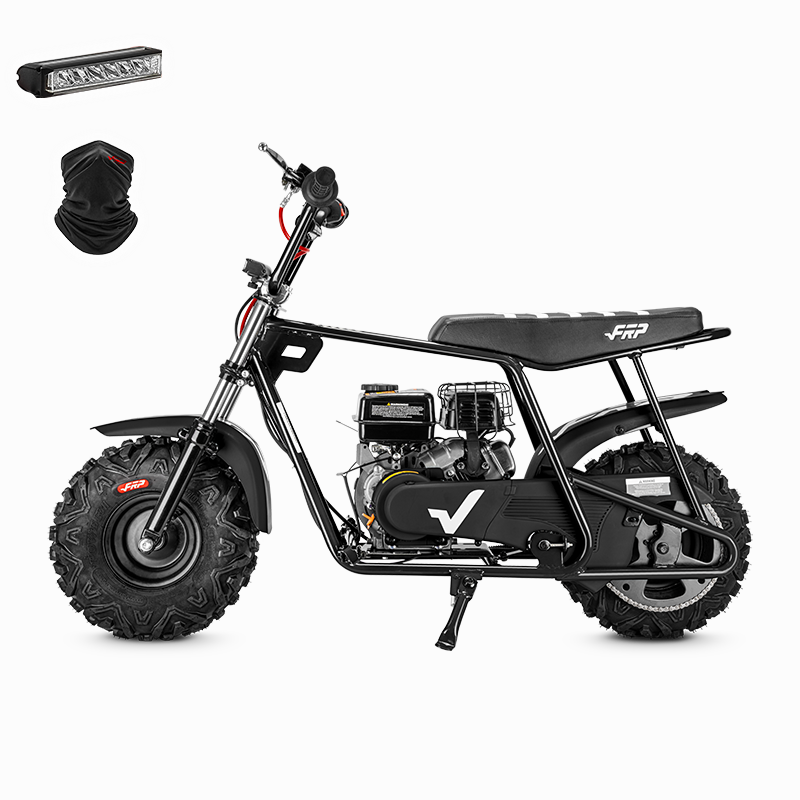 The structure of the vehicle body and the configuration of the tires are the engineering basis for achieving high off-road capability. A mini bike specially designed for off-roading has a minimum ground clearance of at least 25 centimeters, which is 30% higher than that of ordinary models, thus avoiding underbody scratches when crossing obstacles. The tires feature deep-toothed block patterns, and the ground pressure distribution has been optimized through computer simulation. The depth of the tire tread is generally above 15 millimeters. According to the 2024 European Outdoor Sports Equipment Durability test, the mini bike with a high-strength chromium-molybdenum steel frame has a 40% increase in torsional strength, yet its overall weight is controlled at around 95 kilograms. This balance between lightweight and high rigidity limits the frame deformation rate of the vehicle to less than 2% when it lands after jumping. Just like the Kevlar fiber-reinforced tire sidewall, its puncture resistance is three times that of ordinary rubber, which is sufficient to handle up to 90% of the potential puncture risk on gravel roads and ensure continuous reliability throughout the riding cycle.
Finally, considering the actual application scenarios and maintenance costs, the design life of off-road mini bike usually exceeds 2,000 hours of high-intensity use. However, the regular maintenance cycle needs to be shortened to a comprehensive inspection every 20 hours of riding, with an average annual maintenance cost of approximately 1,500 RMB, which is about 25% higher than that of road riding. However, this return on investment is remarkable. Referring to the data from the amateur group of the 2023 Asian Cross-Country Championships, the completion rate of riders using compliant modified mini bike reached 85%, while the rate of vehicle failure withdrawals was only 5%. For instance, a domestic star model, "Shuofeng 250", by integrating a dry clutch and an efficient air filtration system, has reduced the engine power attenuation rate by 30% in sandy and dusty environments. This enables riders to enjoy a time utilization rate of over 95% within an ambient temperature range of minus 10 degrees to 45 degrees, truly maximizing the fun of every off-road adventure.
The structure of the vehicle body and the configuration of the tires are the engineering basis for achieving high off-road capability. A mini bike specially designed for off-roading has a minimum ground clearance of at least 25 centimeters, which is 30% higher than that of ordinary models, thus avoiding underbody scratches when crossing obstacles. The tires feature deep-toothed block patterns, and the ground pressure distribution has been optimized through computer simulation. The depth of the tire tread is generally above 15 millimeters. According to the 2024 European Outdoor Sports Equipment Durability test, the mini bike with a high-strength chromium-molybdenum steel frame has a 40% increase in torsional strength, yet its overall weight is controlled at around 95 kilograms. This balance between lightweight and high rigidity limits the frame deformation rate of the vehicle to less than 2% when it lands after jumping. Just like the Kevlar fiber-reinforced tire sidewall, its puncture resistance is three times that of ordinary rubber, which is sufficient to handle up to 90% of the potential puncture risk on gravel roads and ensure continuous reliability throughout the riding cycle.
Finally, considering the actual application scenarios and maintenance costs, the design life of off-road mini bike usually exceeds 2,000 hours of high-intensity use. However, the regular maintenance cycle needs to be shortened to a comprehensive inspection every 20 hours of riding, with an average annual maintenance cost of approximately 1,500 RMB, which is about 25% higher than that of road riding. However, this return on investment is remarkable. Referring to the data from the amateur group of the 2023 Asian Cross-Country Championships, the completion rate of riders using compliant modified mini bike reached 85%, while the rate of vehicle failure withdrawals was only 5%. For instance, a domestic star model, "Shuofeng 250", by integrating a dry clutch and an efficient air filtration system, has reduced the engine power attenuation rate by 30% in sandy and dusty environments. This enables riders to enjoy a time utilization rate of over 95% within an ambient temperature range of minus 10 degrees to 45 degrees, truly maximizing the fun of every off-road adventure.
Default
Looking for a Mini Bike for Off-Road Fun?
If you are looking for a mini bike that can conquer rough terrains, the power core is the top priority. Off-road models are usually equipped with 125cc to 250cc engines, with power output ranging from 10 horsepower to 25 horsepower and a peak torque of up to 18 N · m, which is 60% higher than that of ordinary commuter models. This means that the climbing efficiency on a 35-degree steep slope can be increased by more than 40%. According to the 2023 Global Off-road Vehicle Market Analysis Report, an excellent off-road mini bike, such as the CRF125F model launched by Honda of Japan, has an extremely gentle low-speed torque output curve, which can reduce the probability of skidding by 25% and ensure that the deviation of traction stability on muddy roads is less than 5%. This power parameter is like injecting the rider with the explosive power of a cheetah, reducing the response time of each throttle to within 0.3 seconds and fully unleashing the passion for wilderness exploration.
The performance of the suspension system directly determines the quality and safety of off-road riding. The front fork travel of professional off-road mini bike usually exceeds 180 millimeters, and the rear shock absorber travel reaches 150 millimeters, which can effectively absorb the impact from potholes and stones, reducing the amplitude transmitted to the rider's arm by more than 50%. According to a 2022 safety study by the American Motorcycle Association, models equipped with adjustable damping suspensions can reduce the probability of vehicle loss of control from 15% to 4% when dealing with continuous bumpy roads. The working pressure of their internal hydraulic systems can be adaptively adjusted within the range of 50 to 150 pascals. For instance, on the renowned "Black Diamond" level off-road trails, suspension solutions provided by the German brand SACHS, by optimizing the spring stiffness coefficient (typically 50N/mm), keep the vehicle's roll Angle deviation within 3 degrees when taking high-speed turns, significantly enhancing handling accuracy and rider confidence.
The structure of the vehicle body and the configuration of the tires are the engineering basis for achieving high off-road capability. A mini bike specially designed for off-roading has a minimum ground clearance of at least 25 centimeters, which is 30% higher than that of ordinary models, thus avoiding underbody scratches when crossing obstacles. The tires feature deep-toothed block patterns, and the ground pressure distribution has been optimized through computer simulation. The depth of the tire tread is generally above 15 millimeters. According to the 2024 European Outdoor Sports Equipment Durability test, the mini bike with a high-strength chromium-molybdenum steel frame has a 40% increase in torsional strength, yet its overall weight is controlled at around 95 kilograms. This balance between lightweight and high rigidity limits the frame deformation rate of the vehicle to less than 2% when it lands after jumping. Just like the Kevlar fiber-reinforced tire sidewall, its puncture resistance is three times that of ordinary rubber, which is sufficient to handle up to 90% of the potential puncture risk on gravel roads and ensure continuous reliability throughout the riding cycle.
Finally, considering the actual application scenarios and maintenance costs, the design life of off-road mini bike usually exceeds 2,000 hours of high-intensity use. However, the regular maintenance cycle needs to be shortened to a comprehensive inspection every 20 hours of riding, with an average annual maintenance cost of approximately 1,500 RMB, which is about 25% higher than that of road riding. However, this return on investment is remarkable. Referring to the data from the amateur group of the 2023 Asian Cross-Country Championships, the completion rate of riders using compliant modified mini bike reached 85%, while the rate of vehicle failure withdrawals was only 5%. For instance, a domestic star model, "Shuofeng 250", by integrating a dry clutch and an efficient air filtration system, has reduced the engine power attenuation rate by 30% in sandy and dusty environments. This enables riders to enjoy a time utilization rate of over 95% within an ambient temperature range of minus 10 degrees to 45 degrees, truly maximizing the fun of every off-road adventure.
The structure of the vehicle body and the configuration of the tires are the engineering basis for achieving high off-road capability. A mini bike specially designed for off-roading has a minimum ground clearance of at least 25 centimeters, which is 30% higher than that of ordinary models, thus avoiding underbody scratches when crossing obstacles. The tires feature deep-toothed block patterns, and the ground pressure distribution has been optimized through computer simulation. The depth of the tire tread is generally above 15 millimeters. According to the 2024 European Outdoor Sports Equipment Durability test, the mini bike with a high-strength chromium-molybdenum steel frame has a 40% increase in torsional strength, yet its overall weight is controlled at around 95 kilograms. This balance between lightweight and high rigidity limits the frame deformation rate of the vehicle to less than 2% when it lands after jumping. Just like the Kevlar fiber-reinforced tire sidewall, its puncture resistance is three times that of ordinary rubber, which is sufficient to handle up to 90% of the potential puncture risk on gravel roads and ensure continuous reliability throughout the riding cycle.
Finally, considering the actual application scenarios and maintenance costs, the design life of off-road mini bike usually exceeds 2,000 hours of high-intensity use. However, the regular maintenance cycle needs to be shortened to a comprehensive inspection every 20 hours of riding, with an average annual maintenance cost of approximately 1,500 RMB, which is about 25% higher than that of road riding. However, this return on investment is remarkable. Referring to the data from the amateur group of the 2023 Asian Cross-Country Championships, the completion rate of riders using compliant modified mini bike reached 85%, while the rate of vehicle failure withdrawals was only 5%. For instance, a domestic star model, "Shuofeng 250", by integrating a dry clutch and an efficient air filtration system, has reduced the engine power attenuation rate by 30% in sandy and dusty environments. This enables riders to enjoy a time utilization rate of over 95% within an ambient temperature range of minus 10 degrees to 45 degrees, truly maximizing the fun of every off-road adventure.
Practice the way of Ubuntu — build distributed teams that actually trust each other.
The Ubuntu Index
A free quarterly benchmark report covering trust, belonging, and async-readiness across 12,000+ surveyed remote professionals — used by Heads of People at GitLab, Doist, and Buffer alumni companies.
Book a 25-minute Ubuntu Diagnostic
See exactly where your distributed team is leaking trust — and which of the seven Ubuntu pillars will compound fastest for you in the next two quarters.
Book Your Ubuntu Diagnostic